
Quick Contact
- Attapur, Tolichouki, Manikonda, Sun City, Hyderabad
- 9505030603
- 9441695593
- swamysakes17@gmail.com
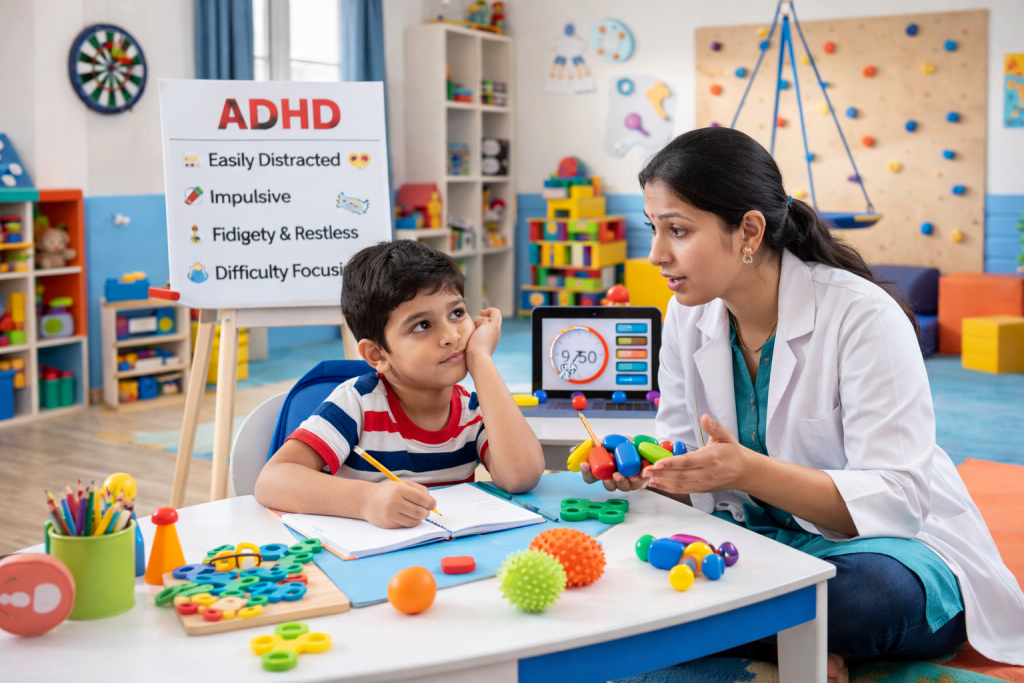
Specific Learning Disabilities (SLD) refer to a group of disorders that affect a person’s ability to acquire and use academic skills. Among these, dyslexia is one of the most common types. Dyslexia: Dyslexia is a specific learning disability that primarily affects reading and related language-based processing skills. It is characterized by difficulties with accurate and/or fluent word recognition and by poor spelling and decoding abilities. These difficulties typically result from a deficit in the phonological component of language.
Key Characteristics of Dyslexia:
Reading Difficulties:
Struggles with decoding words (reading words accurately and fluently).
Difficulty recognizing familiar words.
Slow and laborious reading.
Spelling and Writing Challenges:
Frequent spelling errors, even in simple words.
Difficulty with spelling patterns and rules.
Trouble organizing written work.
Phonological Processing Issues:
Difficulty understanding and processing the sounds in words.
Problems with rhyming, syllable counting, and segmenting sounds in words.
Signs and Symptoms:
In Early Childhood:
Delayed speech development.
Trouble learning the alphabet, numbers, and basic words.
Difficulty pronouncing words correctly.
In School-Age Children:
Trouble learning to read or write.
Avoiding reading aloud.
Confusing letters and their sounds (e.g., "b" and "d" or "p" and "q").
In Adolescents and Adults:
Difficulty reading unfamiliar words.
Slow reading and writing speed.
Problems with reading comprehension.
Impact of Dyslexia:
Academic Challenges:
Struggles with reading assignments and tests.
Difficulty learning foreign languages.
Emotional and Social Impact:
Low self-esteem due to academic struggles.
Anxiety or frustration related to schoolwork.
Management and Support:
Specialized Instruction:
Structured literacy programs that focus on phonics, phonemic awareness, and reading fluency.
Multisensory approaches that engage multiple senses (visual, auditory, kinesthetic).
Accommodations in School:
Extra time on tests and assignments.
Access to audiobooks or text-to-speech technology.
Use of computers for writing tasks.
Supportive Environment:
Encouragement and positive reinforcement from teachers, parents, and peers.
Building on strengths in other areas (e.g., creativity, problem-solving).
With appropriate interventions, individuals with dyslexia can develop strategies to manage their challenges and succeed academically and professionally.
9505030603
swamysakes17@gmail.com
Attapur, ToloChouki, Manikonda,
Sun City, Hyderabad
© 2026. All rights reserved.